
Why it matters
Young people are more than a problem we failed to prevent.
The strongest case for investing during secondary school is not merely that some students might avoid sustained NEET. It is that a much wider cohort may build stronger capability, direction and choices.
The scope correction
NEET prevention matters. It does not get to swallow the entire story.
Not being in employment, education or training is an important outcome—especially when it becomes sustained. But a student can remain technically “non-NEET” while still leaving school with weak confidence, poor pathway information, fragile routines, avoidable debt or a qualification that does not translate into durable opportunity.
He Ara Angitū therefore asks whether structured secondary-school investment can improve a wider set of outcomes:
- engagement, routine and belonging;
- learning, capability and attainment;
- clearer tertiary, vocational, apprenticeship and employment transitions;
- pathway completion and employment continuity;
- financial capability and protected Learning Capital;
- earnings potential, security, agency and life choices.
A statistic can be true and still be too late
NEET tells us who has reached a particular state. It does not tell us every point where confidence, routine, belonging or opportunity began leaking away.
The whole-cohort economic idea
Small improvements across many people can matter.
A participant does not need to move from NEET to non-NEET for the programme to create value. A modest attributable improvement in completion, employment continuity or earnings among a broader group may accumulate into substantial social value.
The model’s earnings sensitivities are not demonstrated programme effects. Stage 0 and the pilot must test whether any broad effect exists, for whom, and for how long.
The political timing problem
A teenager’s development does not pause for a coalition negotiation.
A student entering secondary school may experience multiple governments before completing tertiary training or establishing a career. Their development horizon is longer than one electoral term, but policy is repeatedly designed, renamed, reversed or abandoned inside that shorter cycle.
He Ara Angitū is not New Zealand’s complete 30-year plan. It is one proposal that forces a longer question: what capabilities will today’s young people need to build the country they inherit?
Read the 30-year argument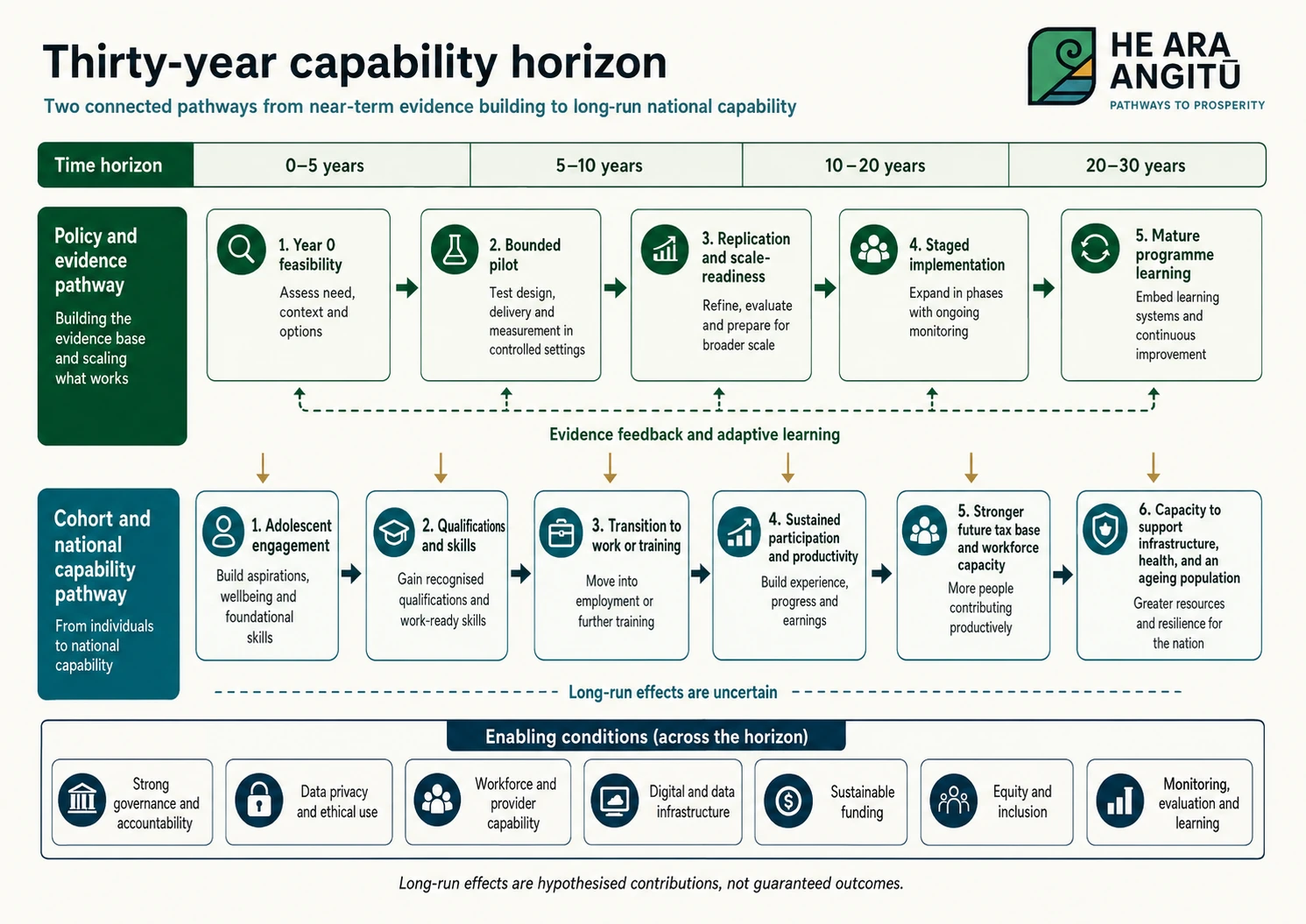
Three perspectives
Value depends on whose ledger you are reading.
Participant
Immediate support, Learning Capital, education and training costs funded, less borrowing, stronger capability and more agency.
Crown
Full cash expenditure, tax and ACC effects, benefit effects, valid student-loan offsets and actual marginal savings.
National social
Earnings, capability, wellbeing, workforce capacity and attributable avoided harms—without pretending social value is Crown cash.
A social BCR is not a government profit-and-loss statement wearing a nicer tie.
See the financial perspectivesWhat remains unknown
The important questions are not hidden in six-point type.
Does the wider cohort respond?
Any earnings, completion or continuity effect must be established causally, not borrowed from unrelated research.
Does targeted support retain strong effects?
The lower-cost structural scenario is promising partly because it assumes strong high-risk effects survive. That is unproven.
Can it be delivered without becoming sludge?
School workload, verification, privacy, appeals, provider capacity and administration costs could weaken or defeat the idea.