
Universal core
A lower-intensity offer for the wider cohort: recognised effort, structured goal-setting, participation, pathway exposure, financial capability and protected Learning Capital.
Open the universal core →New Zealand keeps asking what went wrong after young people disconnect. He Ara Angitū asks what we could build while they are still in school.
The proposal combines recognised effort, mentoring, wider participation, real pathways and protected Learning Capital. It is designed for the whole secondary-school cohort, with stronger targeted support where barriers are higher.
I am Christopher Laidlaw—a carpenter by trade, an engineering student, and a New Zealander who is furious that short political cycles keep passing for long-term leadership.
Young people grow up across several governments. The population ages. Workforce pressures deepen. Yet our national conversation keeps resetting at polling day.
I do not need people to protect my idea. I need them to test it hard enough to find out whether it deserves to exist.
Open the proposal reader, click any paragraph—or highlight the exact words—and the feedback panel will follow that passage. Challenge the evidence, assumptions, financial logic, cultural legitimacy, safeguards, delivery design or plain-English clarity.
This was always meant to be more than a petition website. The proposal should improve in public before Parliament is asked to take it seriously.
Current deployment status: the interface works in browser-local staging. Until shared publishing is connected, feedback can also be emailed directly from the review panel.
Reduced sustained-NEET risk matters, especially for students facing serious barriers. But it is one part of a broader pathway: stronger routines, confidence, attainment, transition, completion, employment continuity, earnings potential and wider life choices.
Important: each arrow is a mechanism to test—not an effect already proven.
A young person does not have to fall into a statistical hole before helping them creates value.
A lower-intensity offer for the wider cohort: recognised effort, structured goal-setting, participation, pathway exposure, financial capability and protected Learning Capital.
Open the universal core →Additional mentoring, barrier removal, navigation and support for students who face greater risk or more complicated circumstances.
Open the targeted accelerator →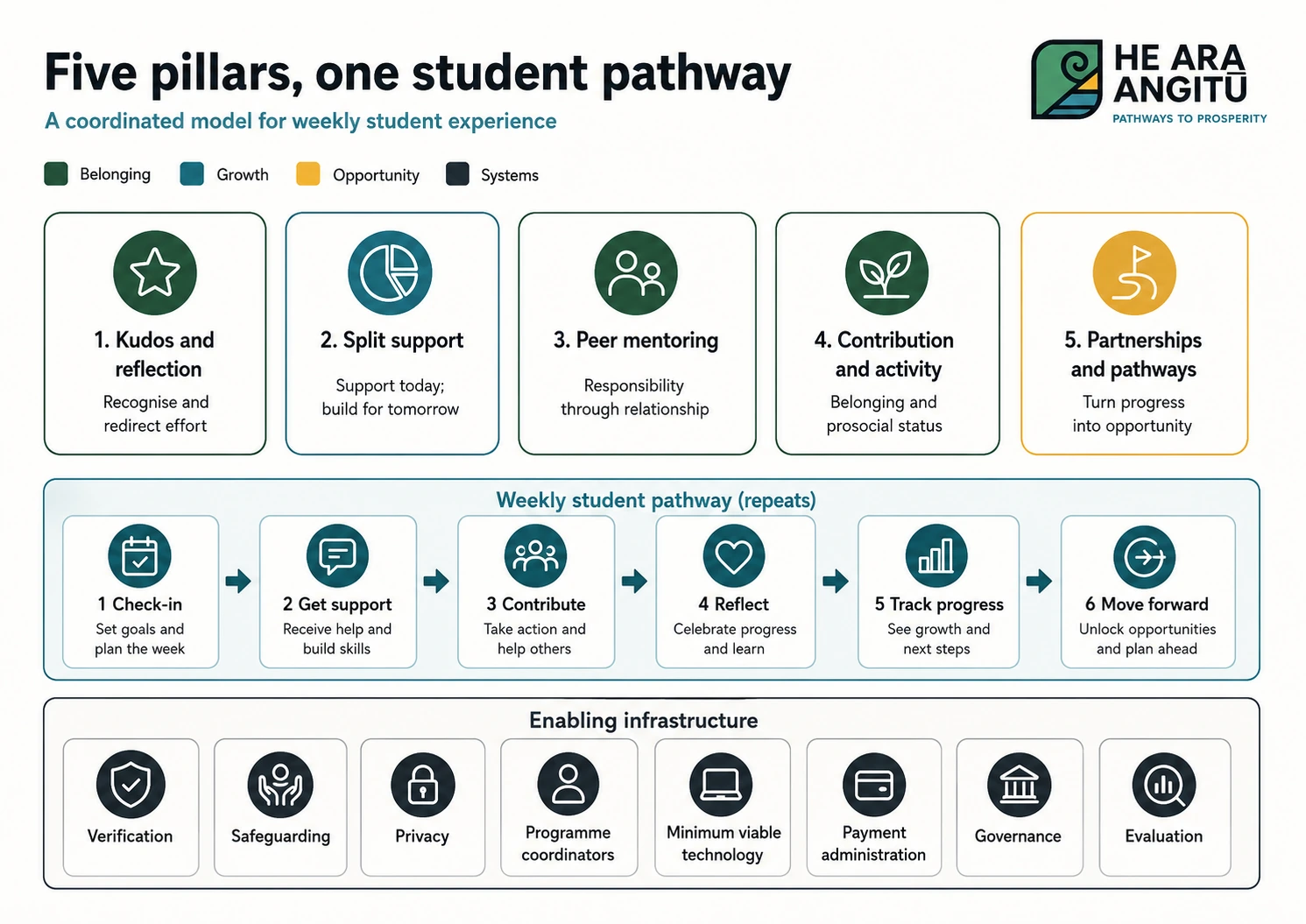
No. That would be wonderfully simple and probably wonderfully useless.
Financial support is one part of a system that also requires goals, participation, mentoring, fair verification and genuine pathways. The protected portion becomes Learning Capital for approved tertiary, vocational or apprenticeship costs.
It is not free money floating around in a teenager’s bank account. It is a protected participant resource, with regulated use and rules that must be designed and tested properly.
How Learning Capital works →The current request is to test legal, delivery, data, cultural, evaluation and economic feasibility. The pilot and national scenarios are future decisions, not approvals hiding in the boot.
Students choose one observable micro-improvement—punctuality, preparation, focus, follow-through, learning practice or contribution—record what happened, and review it honestly with a mentor.
“1% better” is a motivating frame, not a promise that human behaviour compounds like a savings account every day.
What is one small thing I can do better today than I did yesterday?
Small enough to begin. Clear enough to verify. Honest enough to learn from.
Ask Parliament to fund Stage 0 feasibility and co-design. That work must set pre-agreed legal, financial, causal, equity, delivery and harm gates before any pilot decision.
Each stage must earn the right to proceed.