
Feasibility and co-design
$5.3m central estimateDesign legal, data, privacy, cultural, delivery, economic and evaluation architecture. Establish the full business case and pre-agreed thresholds.
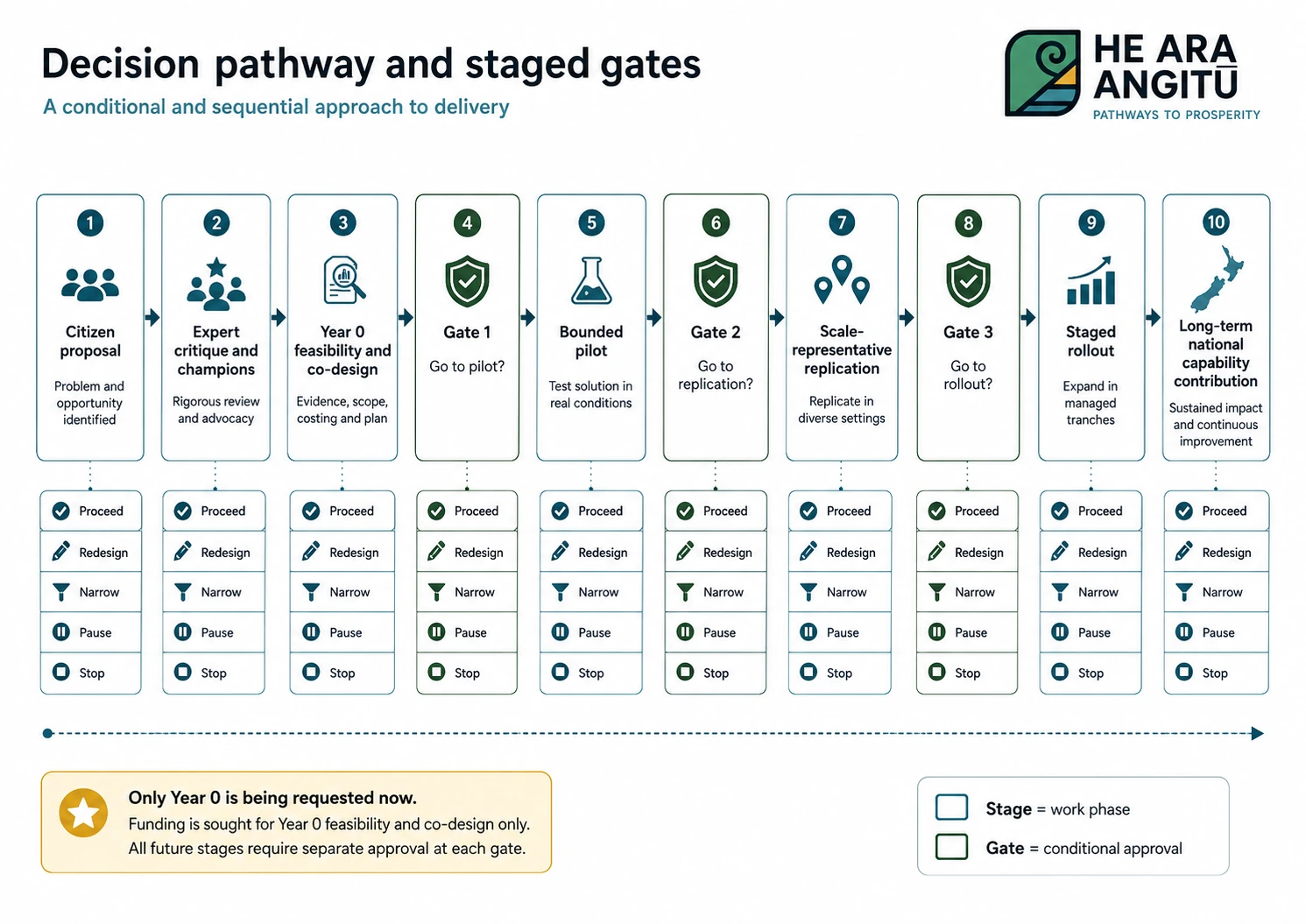
The proposal moves through explicit decisions: Stage 0, a possible bounded pilot, and only then a separate question about redesign, stopping or conditional scale.
Design legal, data, privacy, cultural, delivery, economic and evaluation architecture. Establish the full business case and pre-agreed thresholds.
Proceed only if Stage 0 clears its gates. Independently test implementation, participation, causal outcomes, costs, equity and harms.
National scale requires credible evidence, an affordable design, delivery capacity and public approval through the normal machinery of government.
Can consent, data separation, appeals, account governance and youth protections be designed lawfully?
Can schools and partners operate the process without unmanageable workload, unequal access or an IT build eating the programme?
Can the pilot identify causal effects across universal and targeted components with adequate sample size and follow-up?
Are the pilot costs credible, the counterfactuals defensible and the evidence hurdles explicit?
Has the design been shaped through proper partnership rather than a Māori name being used as decorative authority?
Can stigma, exclusion, coercion, gaming, industry capture and unequal school capacity be controlled?
Engagement, attainment, transition, completion, employment continuity and sustained-NEET outcomes measured without double counting.
Who benefits, who does not, and whether effects differ by need, location, ethnicity, disability, school type or pathway.
Participation, verification burden, mentor capacity, appeals, drop-off, provider quality and actual administration cost.
Observed resource use, genuine borrowing displacement, fiscal effects and value against published thresholds.
Stigma, surveillance, gaming, displacement, oversupply, wage suppression, narrowing of learning or coercive employer influence.
The pilot should not survive because cancelling it embarrasses somebody. It should survive only if the evidence supports a defined next step.